
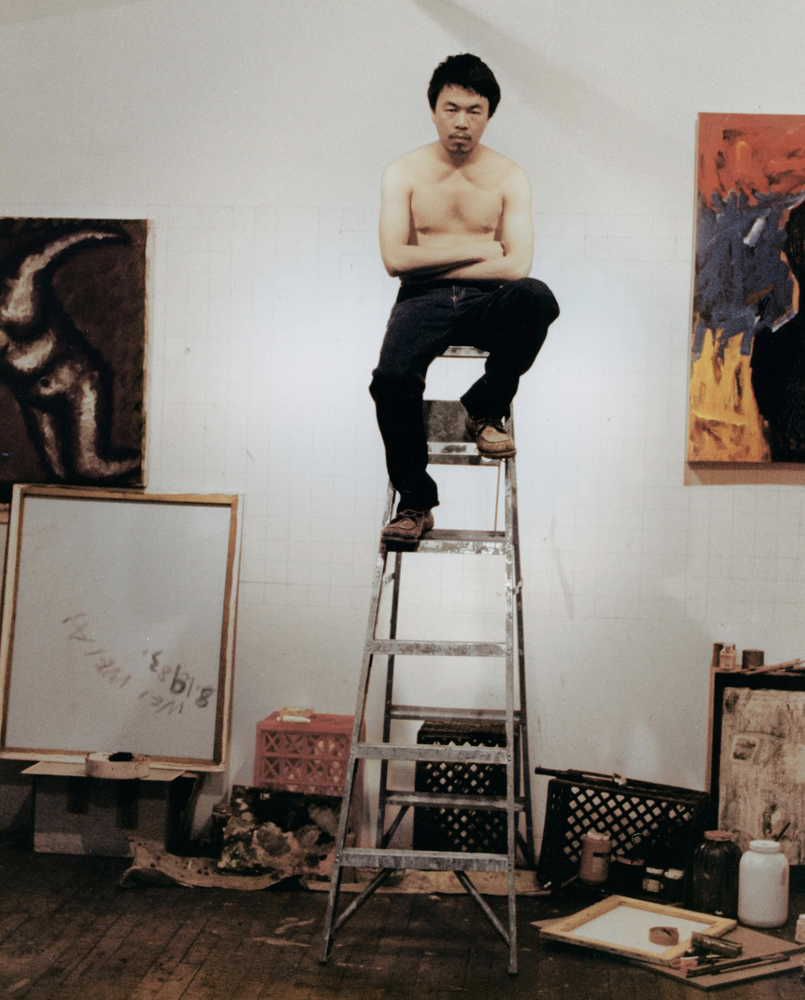
Ai Weiwei at his Hudson Street apartment and studio, in New York, 1983.
"Everything is art. Everything is politics.” That’s Ai Weiwei, summarizing both his life and his work. The Chinese contemporary artist is the son of a so-called enemy of the state. His father, Ai Qing, was a poet who was also a member of the Communist Party, and yet he was exiled to a labor camp in “Little Siberia” in 1958, after defending colleagues accused of “anti-party sentiment.”
A vocal critic of authoritarianism, government corruption, and human-rights abuses, as well as a staunch defender of freedom of speech, Weiwei has never had difficulty getting his points across. His most revered installations were blunt in their messaging. In 1995, his photographic series Dropping a Han Dynasty Urn—in which he literally dropped and broke a 2,000-year-old urn—invoked the mass destruction of artifacts during China’s Cultural Revolution. And 2010’s Sunflower Seeds, composed of millions of porcelain pieces that viewers walked over, represented the downtrodden Chinese people.